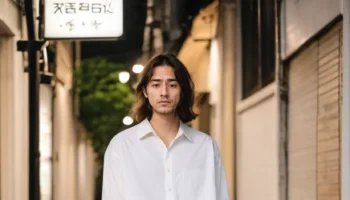
Harajuku Men Outfits: Bold, Creative & Wonderfully Feminine
Tokyo’s Harajuku district has long been a laboratory for the world’s most daring fashion experiments, and in recent years, men have stepped firmly into the spotlight of this kaleidoscopic scene. Forget the tired rules about what menswear is “supposed” to look like — harajuku men outfits shred those conventions with joyful abandon, layering tulle over denim, mixing plaid with lace, and pairing oversized graphic tops with tutus and pastel skirts. This is fashion as self-expression in its purest form: playful, feminine-leaning, proudly colorful, and completely without apology. In this lookbook, we’ll explore the history of the scene, the garments that define it, the accessories that amplify it, and practical ways you can bring a touch of Harajuku into your own wardrobe, whether you want to go full-throttle or just experiment with a single statement piece.
Harajuku Street Style: An Introduction to Tokyo’s Most Creative District
Harajuku isn’t so much a single style as it is an entire ecosystem of overlapping subcultures — Decora, Fairy Kei, Visual Kei, Lolita, Dolly Kei, Gyaru, and countless hybrids that defy easy categorization. What ties them together is an ethos of creative freedom, a refusal to dress for other people’s approval, and a love of layering, color, and contrast. The district around Takeshita Street and Omotesando became famous in the 1990s and early 2000s when young Japanese creatives began using Sunday afternoons as an informal fashion runway, photographed endlessly by street-style magazines like FRUiTS.
For men, the Harajuku scene has always been a sanctuary from the rigid expectations of Japanese corporate culture and the narrow definitions of masculinity pushed by mainstream media. Here, boys wear ribbons in their hair, paint their nails, pile on pastel plush accessories, and walk out in tutu skirts without flinching. The movement owes a debt to artists like the late designer Hiroshi Fujiwara and the continuing influence of genderless kei idols such as Ryucheru and Genking, who normalized softer, more fluid presentations of masculinity for an entire generation.
What makes men in harajuku fashion particularly compelling is the way they blend traditionally feminine silhouettes — ruffles, full skirts, bows — with a distinctly confident, almost punk-rock attitude. It’s not drag, and it’s not costume. It’s a personal uniform built from whatever brings the wearer joy. The scene rewards originality above all, which means no two Harajuku men ever really look alike, even when they’re shopping from the same boutiques.
Gallery: Men in Harajuku Outfits That Are Bold and Beautiful
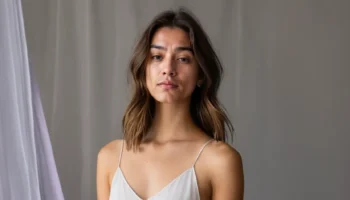
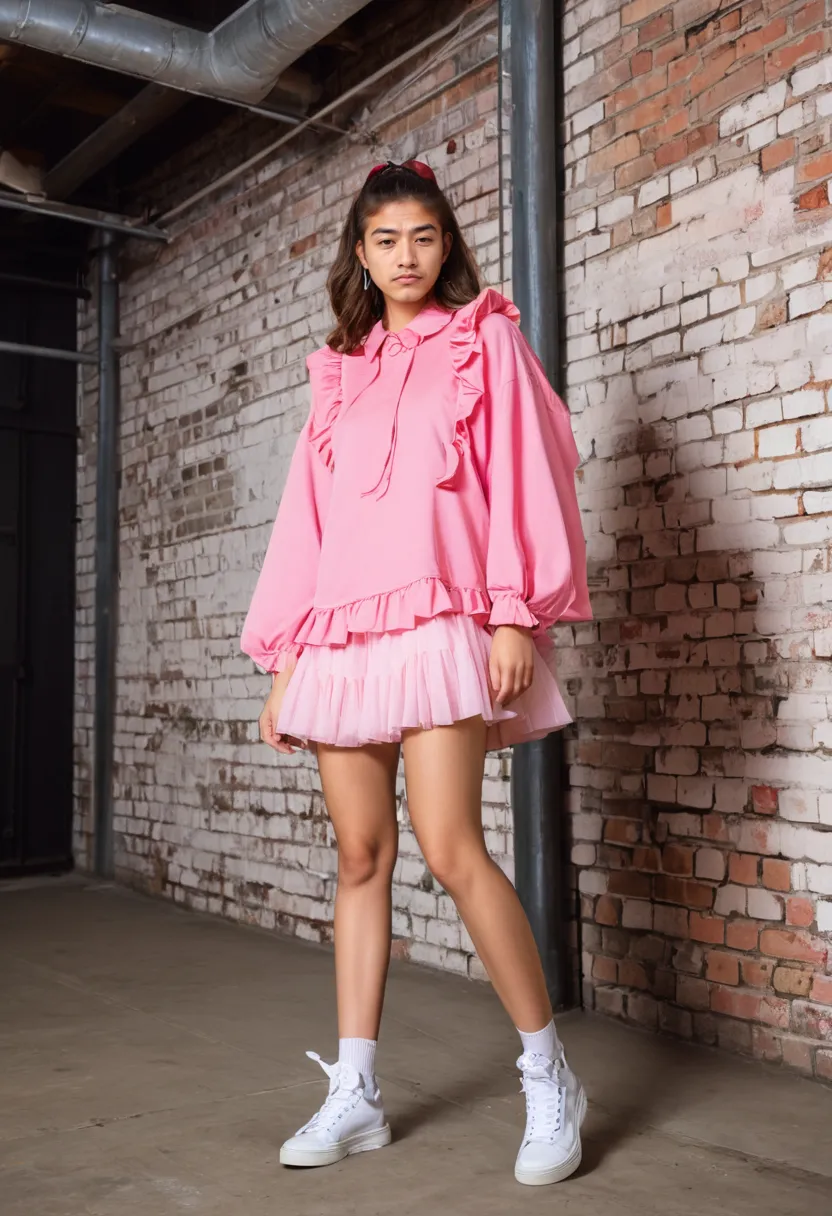
The gallery below captures the sheer visual energy of harajuku street style men at its most expressive. In the first look, a boy stands against the warm texture of a brick wall inside a cavernous industrial loft, wearing an outfit that reads like a love letter to layering. A bright pink tutu skirt — all fluffy tulle and exaggerated volume — sits over a pair of candy-striped tights that pull the eye downward in rhythmic horizontal lines. Above the waist, an oversized graphic top drapes loosely, its slouchy proportions deliberately contrasting with the sculptural poof of the skirt.
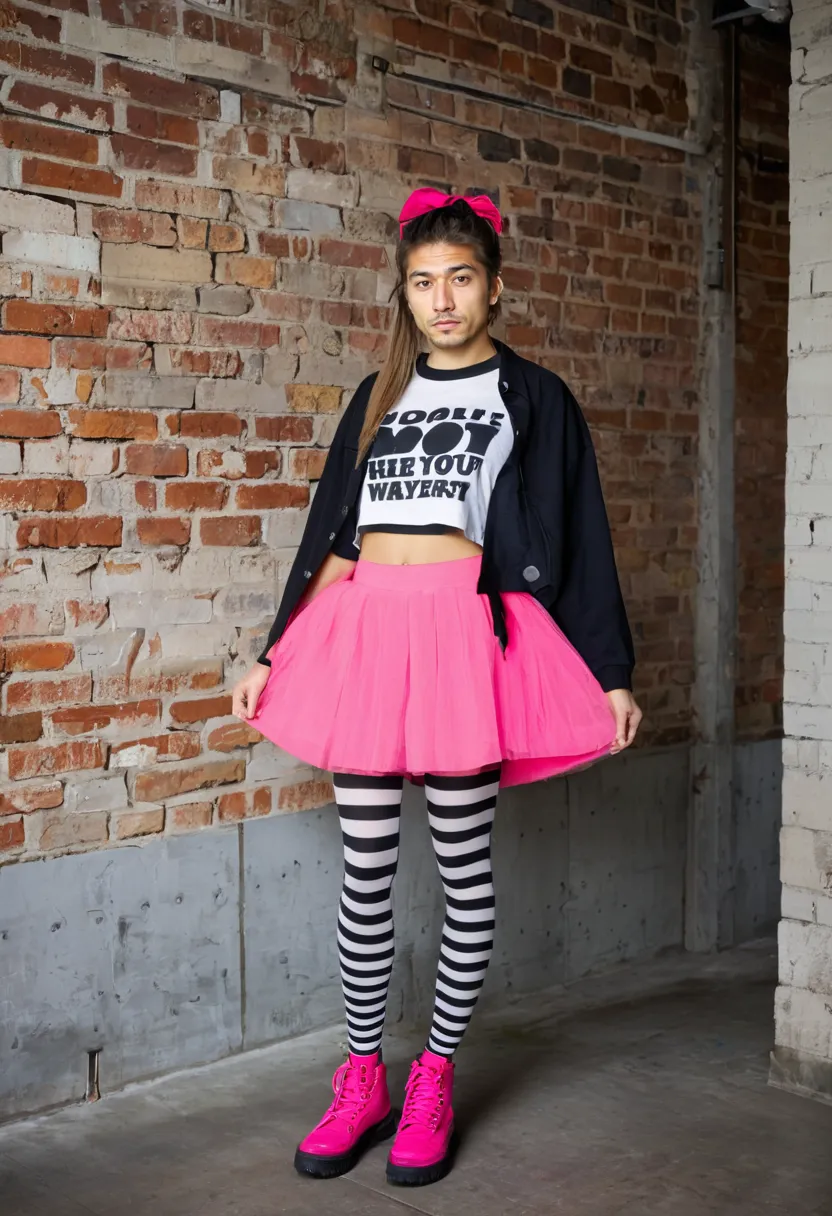
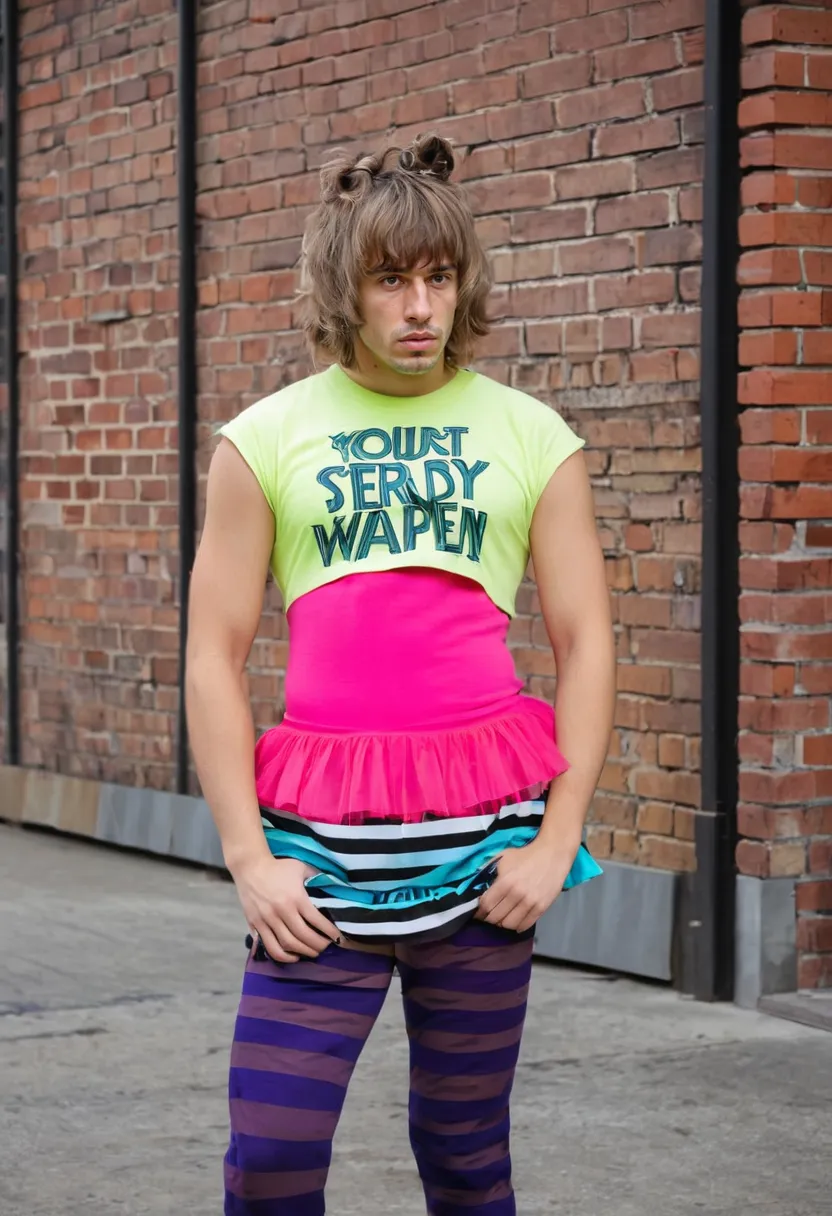
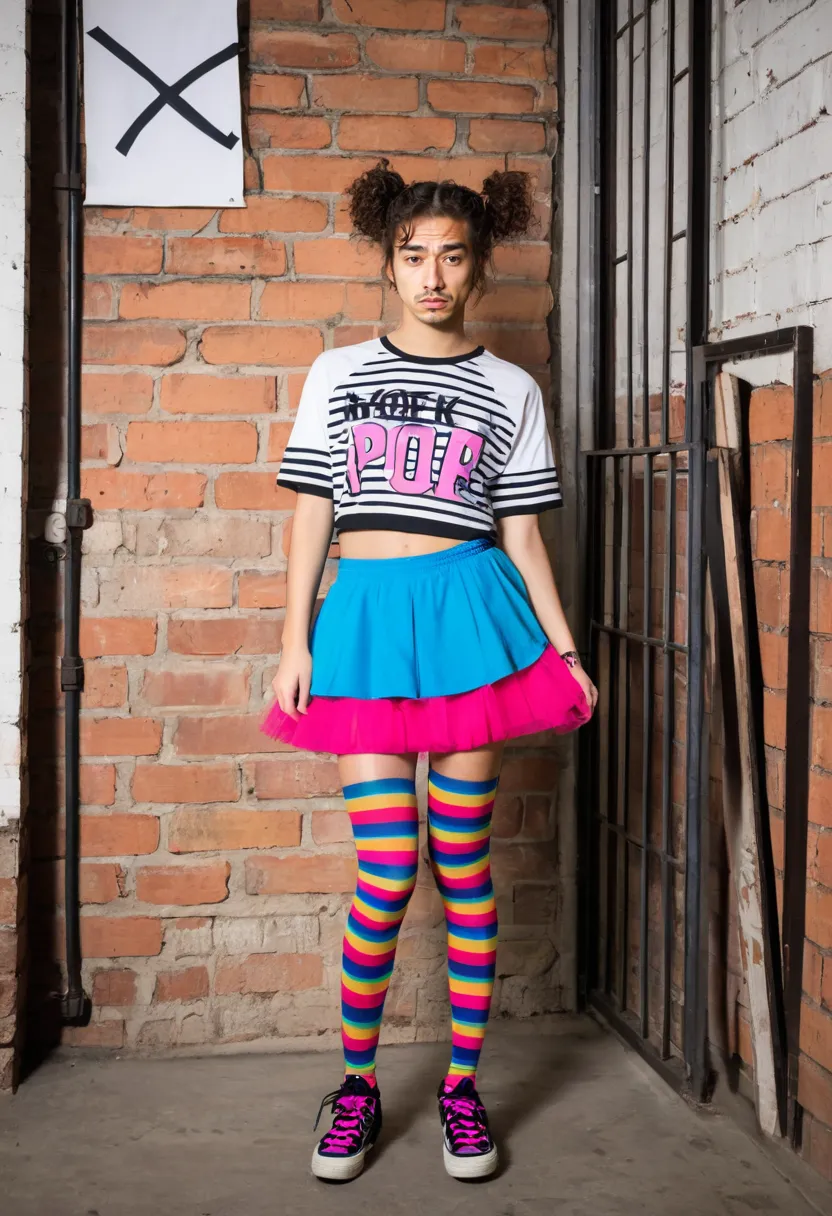
What makes these looks “bold and beautiful” rather than chaotic is the intentionality behind the mixing. The pink of the tutu is echoed in subtle ways across the rest of the outfit — perhaps in a lipstick tone, a piece of hair ribbon, a badge pinned to the graphic top — creating a through-line that unifies the chaos. The contrasting bold fabrics (stiff tulle versus soft cotton jersey versus the sheen of tights) add tactile dimension you can almost feel through the screen.
Notice too how the industrial loft setting works in the outfit’s favor. The exposed brick, the raw architectural bones, the hard shadows — all of it throws the softness and sweetness of the clothing into sharper relief. This is a classic Harajuku move: place something delicate and ultra-feminine against a gritty backdrop and let the tension between the two elements do the storytelling. Boys wearing Harajuku understand this intuitively; they aren’t afraid to clash with their environment, because the clash itself is the point.
Key Harajuku Garments That Show Up Again and Again
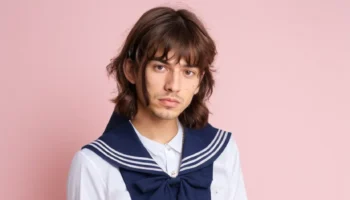
If you study enough japanese harajuku man outfits, certain hero pieces start to emerge as recurring characters. Chief among them is the ruffled blouse — oversized, often in a sugary pastel pink, with voluminous sleeves that billow at the wrist and a cascade of ruffles spilling down the placket. In the image below, this blouse is paired with a layered tutu skirt in matching pink tones, creating a head-to-toe monochromatic statement that feels both romantic and deliberately excessive.
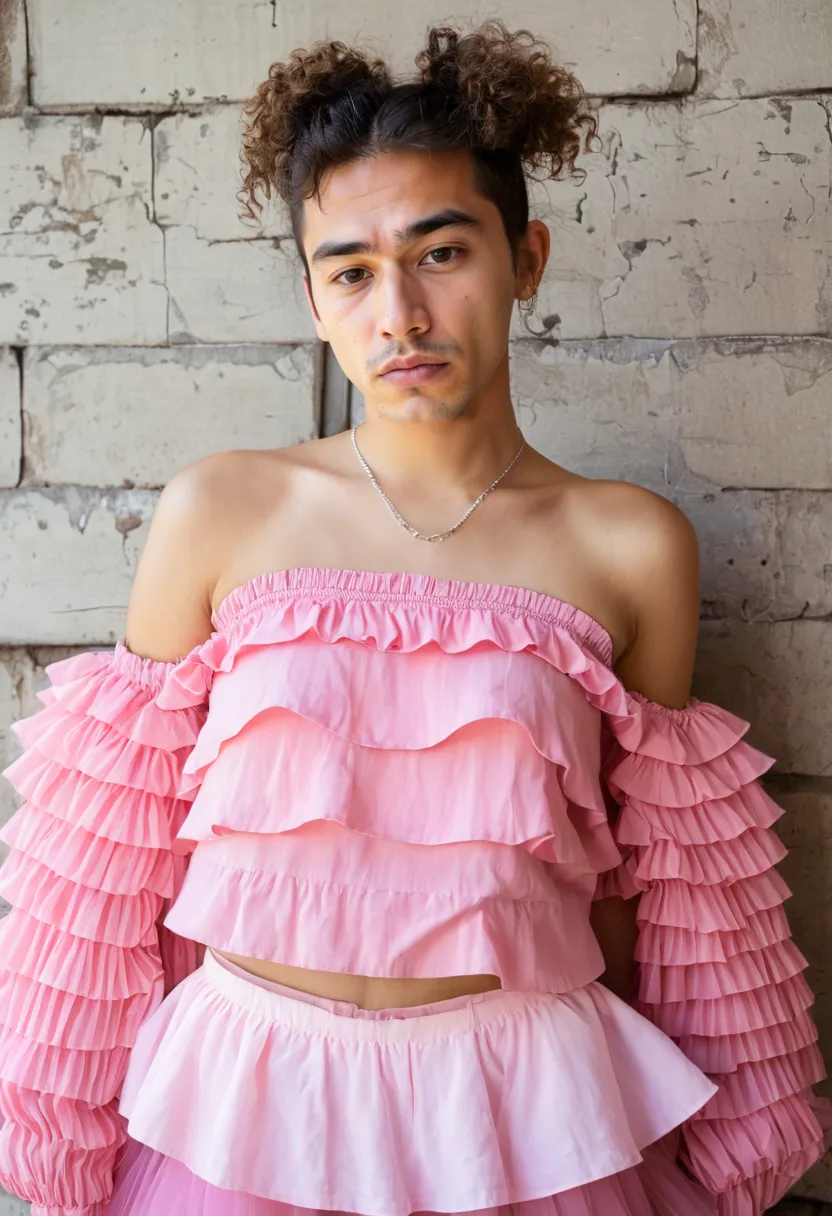
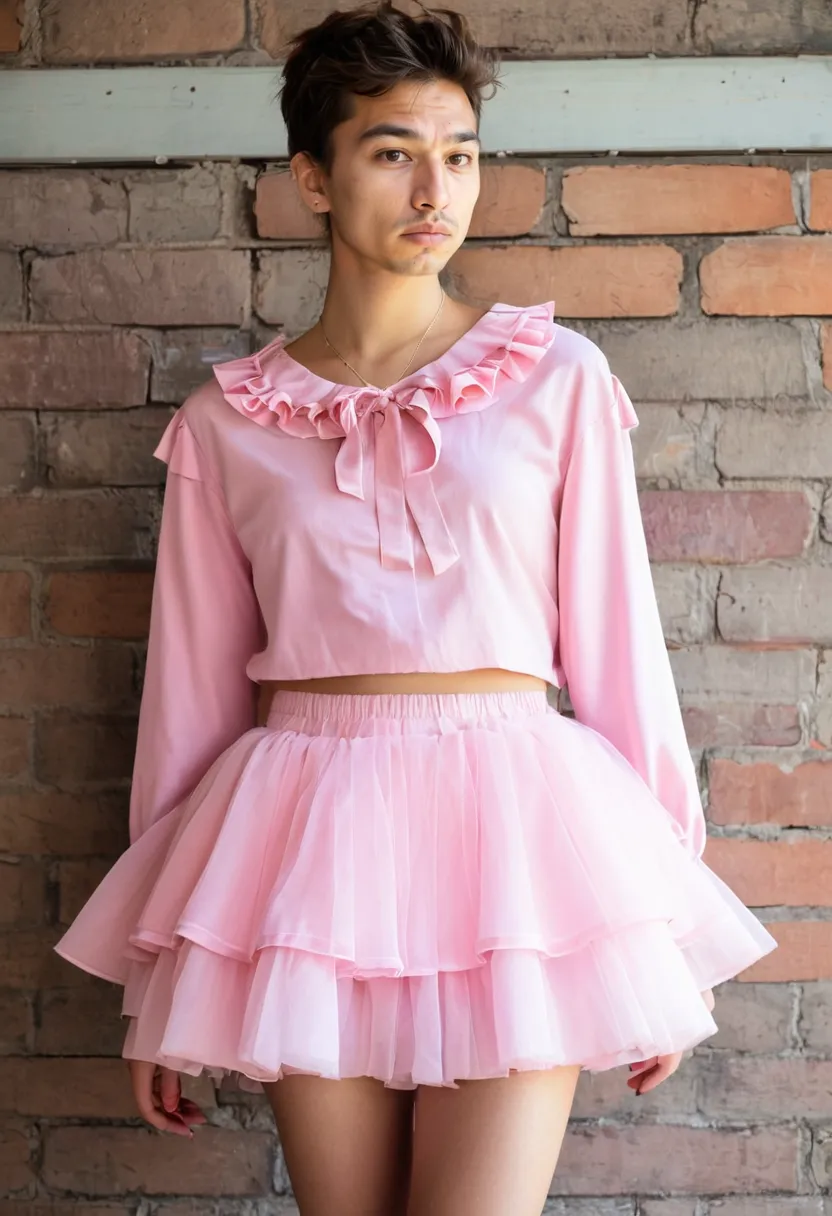
The tutu or tulle skirt is another constant. Unlike a ballet tutu, the Harajuku version is usually knee-length or midi, sometimes multi-tiered, and built to be worn over pants, leggings, or even shorts. The volume matters enormously — it should swish and bounce with every step, drawing attention to the wearer’s confidence rather than hiding the body. Many Harajuku men layer two or three tulle pieces together for maximum drama, mixing colors or stacking sheer over solid.
Oversized graphic sweatshirts and T-shirts are the casual workhorses of the wardrobe. Often featuring cartoon characters, anime references, vintage band logos, or hand-drawn illustrations, these tops provide the “streetwear” anchor that keeps an outfit from tipping fully into costume territory. Platform shoes — chunky creepers, Tokyo Bopper-style mary janes, or towering sneakers — are almost mandatory footwear, adding height and a punkish edge.
Other staples worth knowing include: pleated plaid mini skirts (a crossover with kogal and preppy influences), suspenders and braces worn over blouses, bloomers and petticoats peeking out from under hemlines, oversized cardigans in sorbet shades, striped thigh-high socks, and lace-trimmed shorts. The magic lies in how these pieces are combined. A Harajuku stylist will happily put a rough denim jacket over a princess blouse, or a sweet lace collar over a heavy metal band tee, because the friction between the elements is exactly what gives the look its charge.
Accessories in Harajuku Style: The More the Better
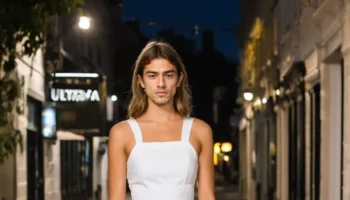
If there is one unshakable commandment of Harajuku dressing, it’s this: never stop at one accessory. The look below illustrates the principle perfectly — a boy layered up in so many pieces that the outfit becomes a kind of wearable collage. Lace peeks out from beneath satin, plaid panels show between pleats, and ribbons, barrettes, and pins seem to accumulate in every direction. It’s maximalism as manifesto.
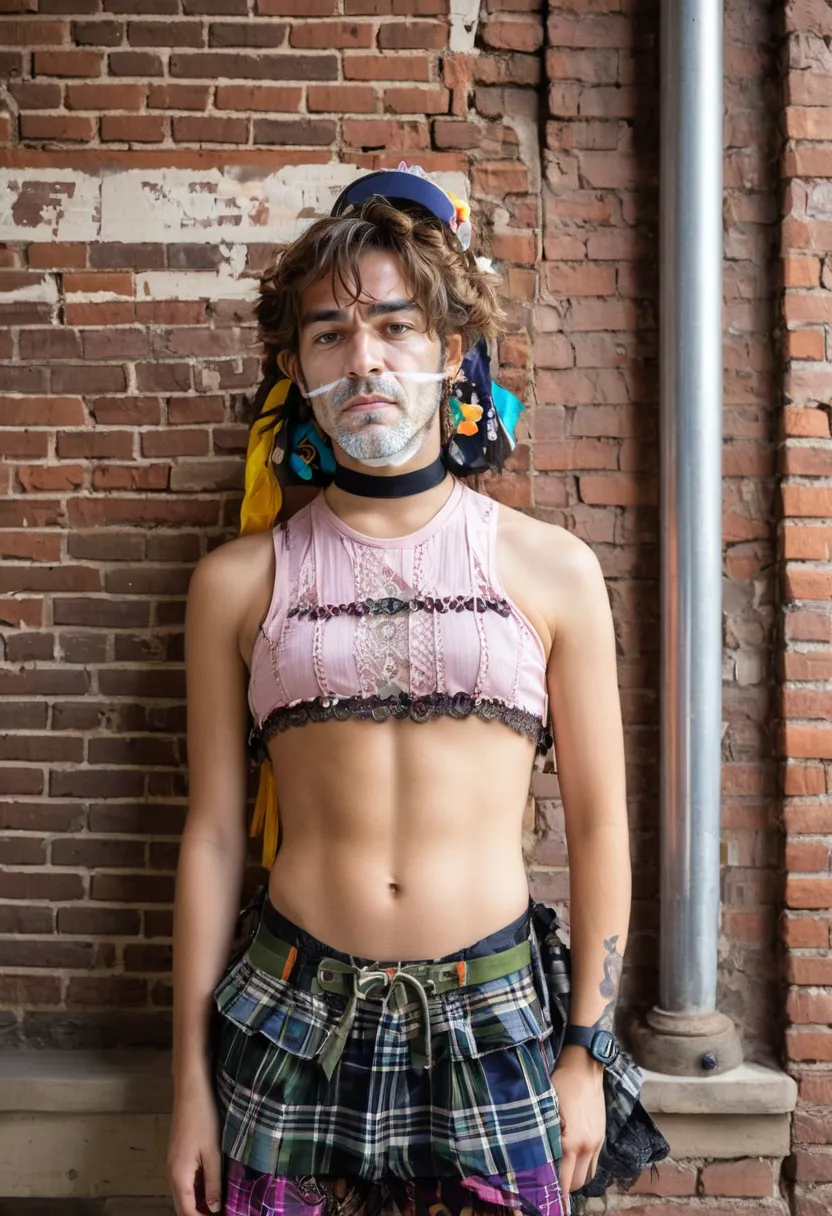
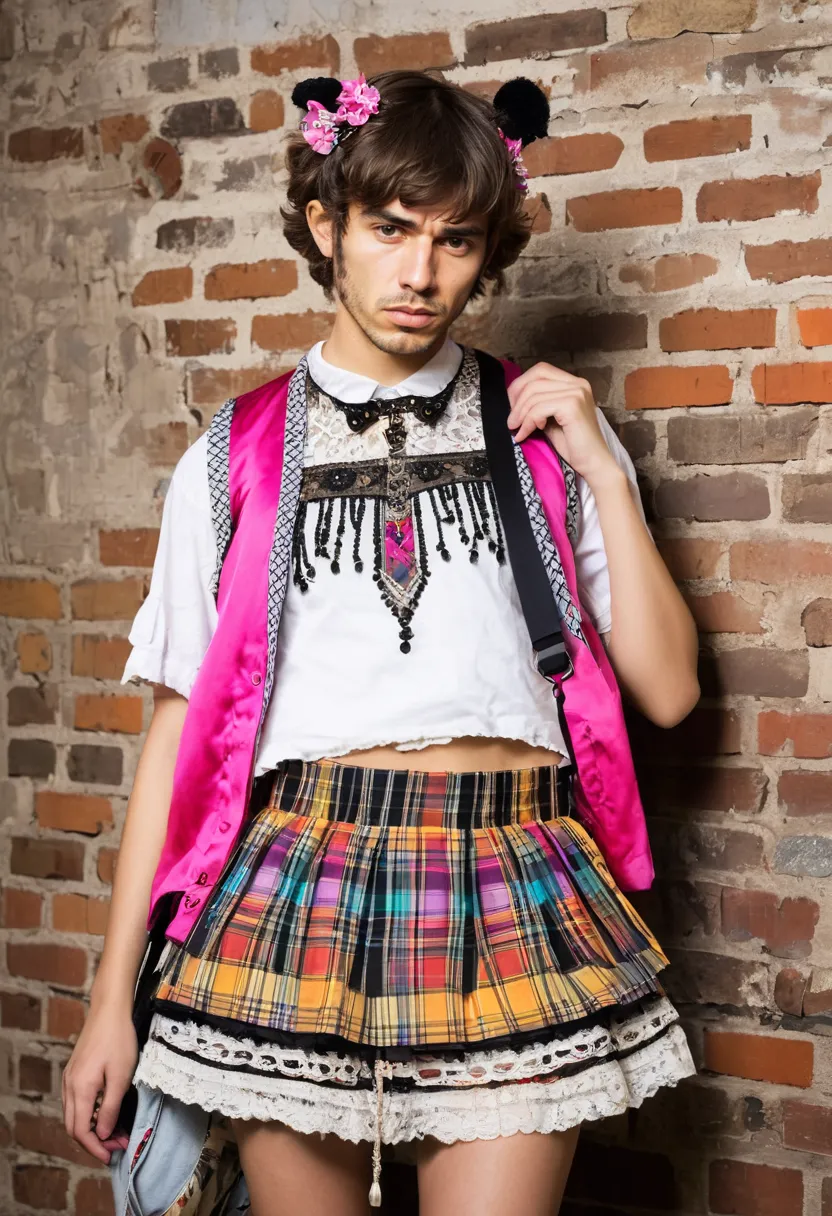
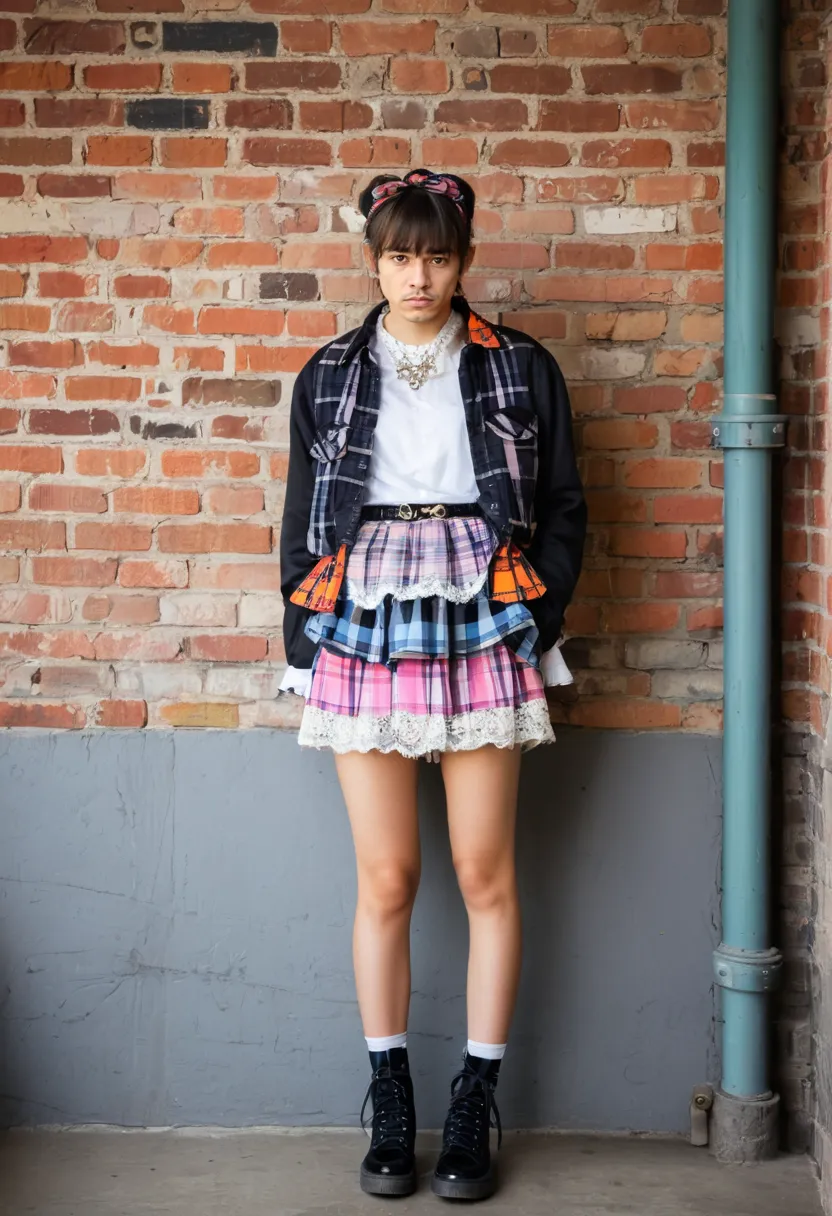
Hair accessories are perhaps the most iconic category. Decora enthusiasts cover their hair in dozens of plastic barrettes in rainbow colors, often arranged in symmetrical rows. Oversized bows, scrunchies, headbands with cat ears or bunny ears, and giant tulle hair clips are all fair game. Boys who keep their hair shorter still find ways to participate through beanies piled with pins, bucket hats covered in embroidered patches, or colorful hair extensions clipped in for a Sunday outing.
Around the neck, you’ll find layered chokers, ribbon ties, lace collars worn detachably, chain necklaces with charms, and pearl strands stacked alongside plastic beads. Wrists are typically stacked with bracelets — silicone bands, charm bracelets, friendship bracelets, and plush cuffs all coexist happily. Bags tend toward the novelty: a plush backpack shaped like a bear, a heart-shaped crossbody, a clear vinyl tote filled with intentionally visible ephemera like stickers and candy wrappers.
Makeup counts as an accessory too in this world. Boys in Harajuku often wear bright blush circled high on the cheeks, glittery eyeshadow, colored eyeliner, and bold lip tints. Nails are frequently decorated with 3D charms, tiny bows, or miniature painted scenes. Face stickers — stars, hearts, rhinestones — applied under the eyes or along the brow bone add the final flourish.
The trick to pulling off this level of accessorizing without looking frantic is rhythm. Repeat a color at least three times across the outfit. Let textures echo one another — if there’s lace at the collar, echo it at the hem or the sock. Balance density with breathing room; if the top half is stacked, let the bottom half simplify, or vice versa. Maximalism, done well, is still composed.
How to Bring Harajuku Influence Into Your Own Wardrobe
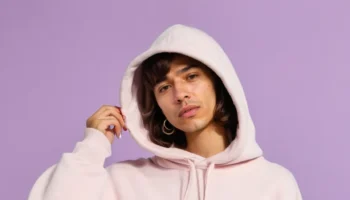
Not everyone is ready to walk into work wearing a floor-length tulle petticoat, and that’s absolutely fine. The beauty of Harajuku is that its spirit can be dialed up or down to suit any comfort level. The outfit shown below offers a brilliant middle-ground blueprint: an oversized graphic sweatshirt paired with a pastel pleated mini skirt, mixing casual streetwear with a feminine silhouette in a way that feels wearable for everyday life outside of Takeshita Street.
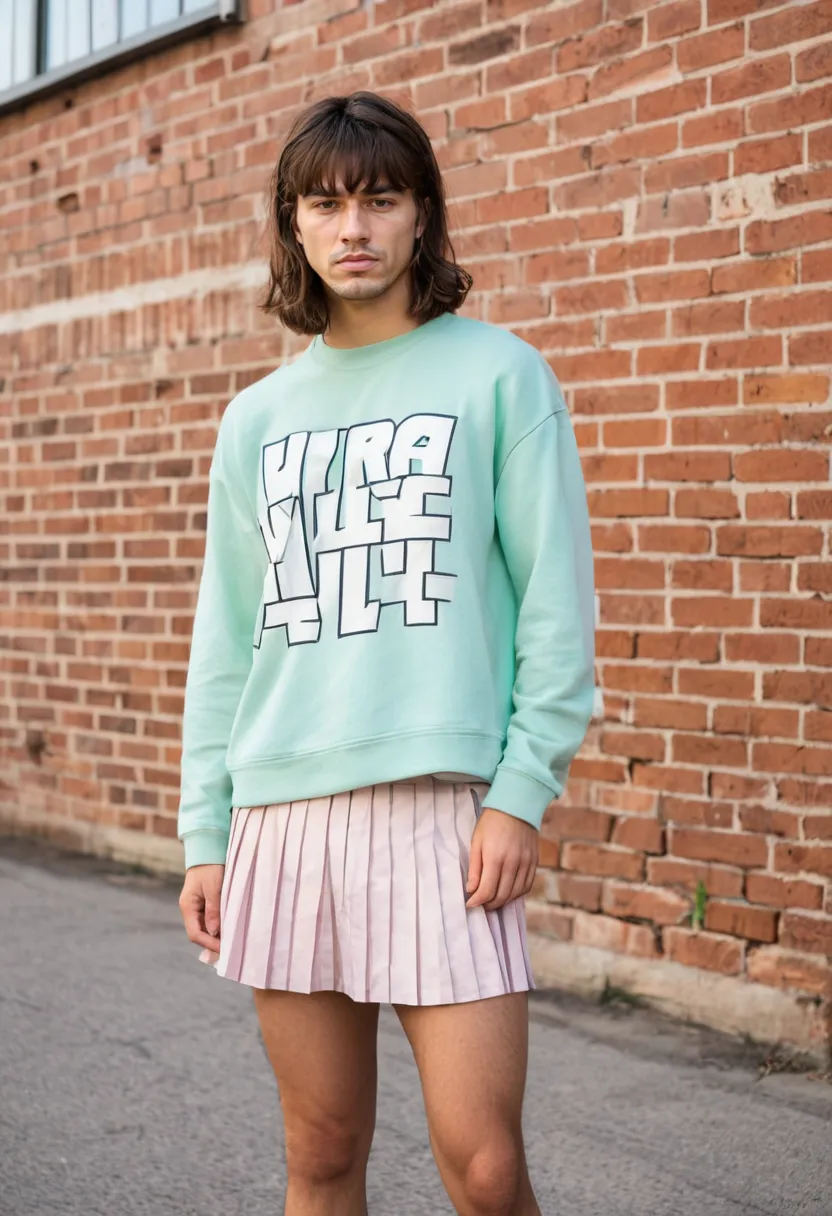
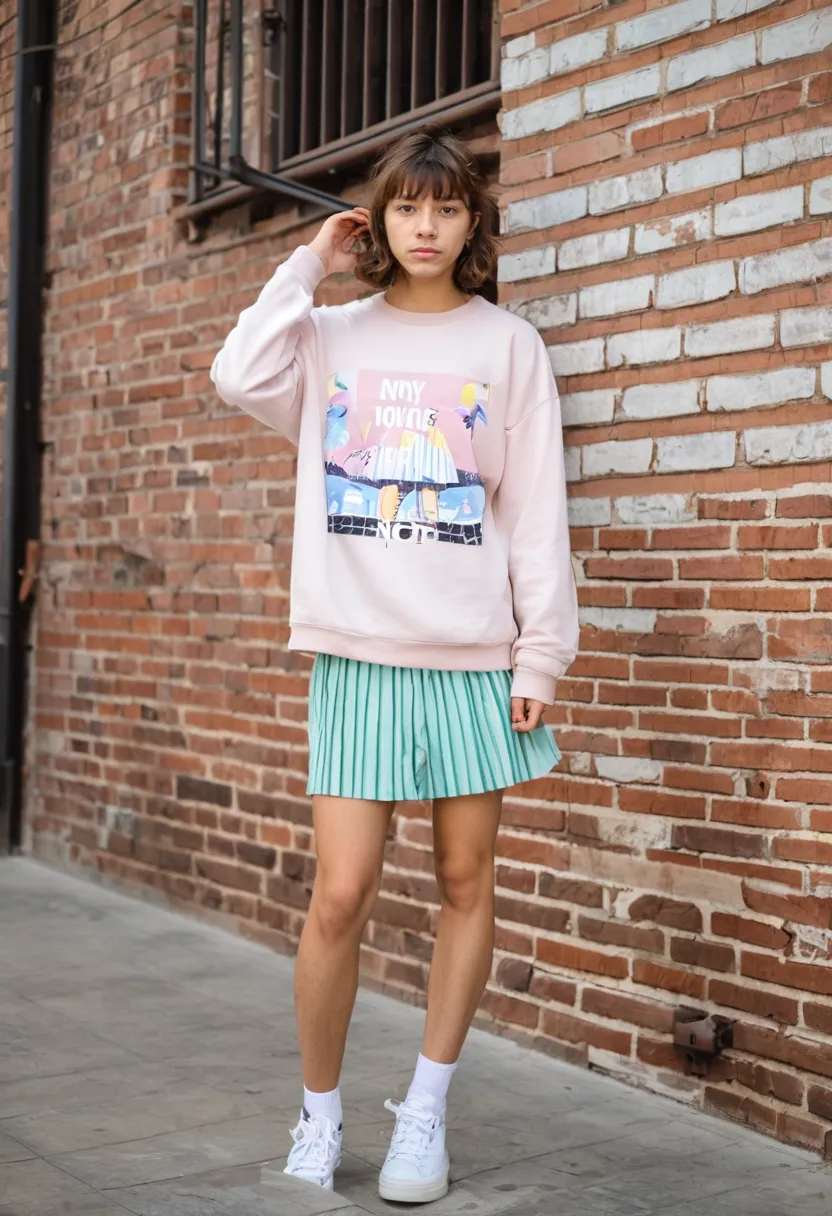
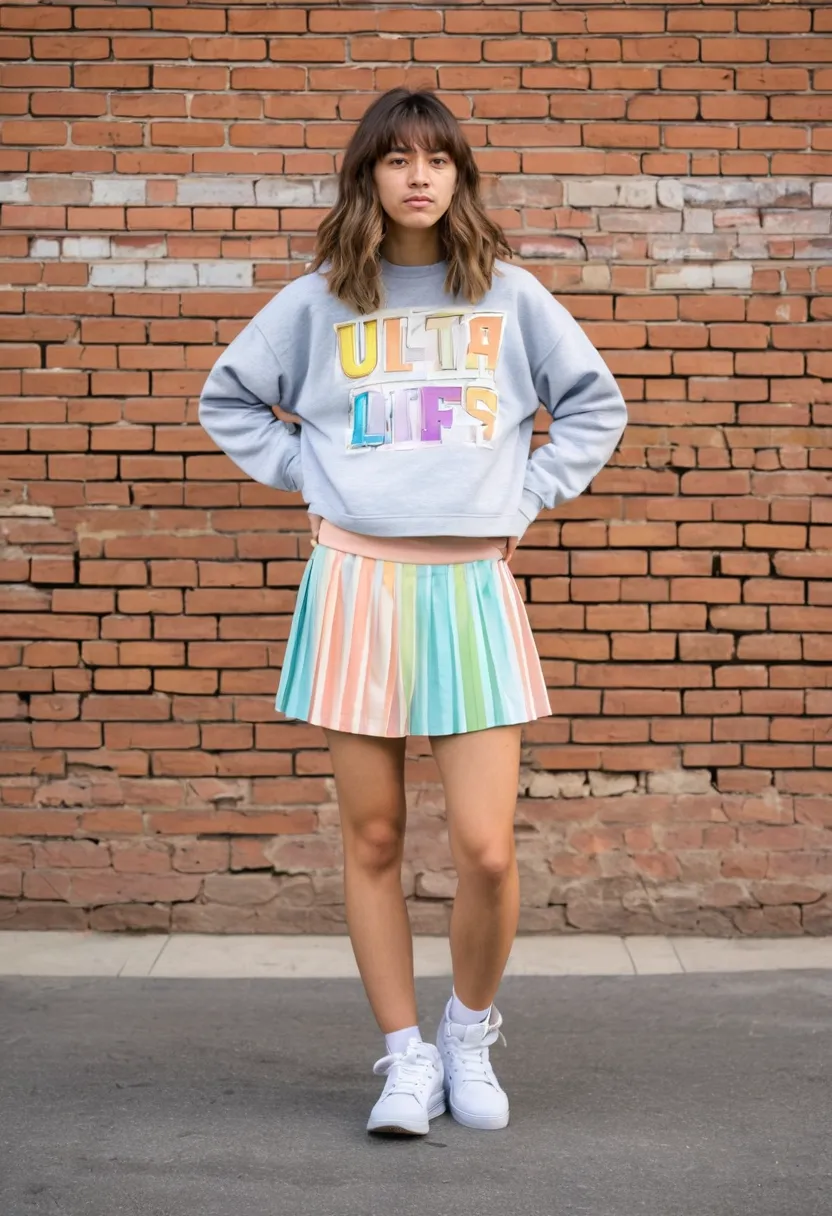
Start with a single statement piece. If you’ve never worn a skirt before, a pleated mini or a short tulle overlay is the easiest entry point because it can be layered over shorts or leggings for a sense of security. Pair it with something you already own and feel confident in — your favorite graphic tee, a well-worn hoodie, a band sweatshirt. The familiarity of the top half will balance the newness of the bottom half and make the whole thing feel less like a leap.
Play with color gradually. If bright pink feels like a lot, begin with pastels — mint, lavender, butter yellow, baby blue. These shades still signal Harajuku’s softness but read as gentler on the eye. As you grow more comfortable, introduce one saturated accent at a time: a hot pink sock, a cherry red ribbon, a neon green barrette. Build up to maximalism rather than diving in cold.
Invest in one pair of platform or chunky shoes. Footwear is the unsung hero of Harajuku styling; the right platform instantly transforms an otherwise plain outfit into something with attitude. Creepers, tall sneakers, or mary janes with thick soles all work beautifully with skirts, shorts, and cropped pants alike.
Master the art of mixing textures. Put something soft next to something stiff. Put lace next to denim. Put shine next to matte. This textural contrast is what elevates harajuku men outfits from “matching pieces” to genuine composition. Even a monochrome look becomes interesting when you layer velvet over cotton over tulle.
Finally, commit to the accessories. Even a simple jeans-and-tee outfit can tilt Harajuku with the addition of a plush backpack, stacked bracelets, a pair of colorful barrettes, or a lace collar layered under a crew neck. Accessories are low-commitment, easy to remove, and give you room to experiment without overhauling your entire wardrobe.
Above all, remember that Harajuku is about joy. The moment it starts to feel like a uniform you’re obligated to wear, you’ve missed the point. Wear what makes you laugh, what makes you feel like yourself at your most imaginative, what you would have worn as a child if no one had told you to stop.
Conclusion
Harajuku men outfits are more than a style — they’re a quiet rebellion against the idea that clothing has to perform a gender, a profession, or a social rank. Whether you go all in with a full pink tutu and ruffled blouse or simply clip a single novelty pin to your backpack, you’re participating in a tradition of creative freedom that stretches back decades and continues to inspire designers, musicians, and everyday dressers around the world. The industrial loft backdrops, the brick walls, the cameras clicking on Takeshita Street — these are just stages. The real magic happens when a boy decides, in the morning, that today he’ll wear the pink one. Embrace the color, the layers, the ribbons, the platforms, and the sheer unapologetic fun of it. Harajuku will meet you wherever you are.
Author: Emma. Photos: Alex Neuron. The material was prepared with the assistance of AI and has undergone quality review.